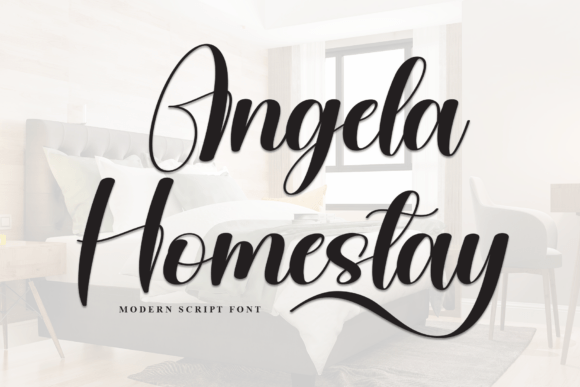
Angela Homestay: A Script Font for Elegant Web Design
I opened the landing page mockup, dropped the headline into a hero section, and switched the typeface to Angela Homestay. The difference was immediate. The brush-inspired strokes and airy letterforms gave the entire layout a sense of warmth and movement, without feeling overly casual. As a web designer, I’m always testing how a script font holds up in real digital environments — not just as a pretty preview, but as a functional part of a responsive layout. Angela Homestay quickly proved it belongs in the toolkit of anyone building boutique brand experiences, creative portfolios, or heartfelt online storefronts.
Testing Angela Homestay in a Hero Section Layout
I built a simple hero block for a fictional creative studio — big image background, semi-transparent overlay, and a short headline in Angela Homestay. The fluid curves and expressive letterforms felt like a natural fit for a display font meant to carry emotion. The font’s contemporary elegance gave the page an editorial polish, the kind that makes a brand feel handcrafted and intentional. The slightly irregular brush strokes added organic texture, which contrasted beautifully against a clean, structured grid. Even at larger sizes, the letter spacing remained well-balanced, and I didn’t need to adjust kerning by hand for the main headline to look polished.
Scaling Across Devices: Mobile and Responsive Behavior
One of the first things I check with any decorative typeface is how it reduces on smaller screens. Angela Homestay held its personality well at around 28–32px, which is common for mobile hero titles. Below that, some of the finer strokes became slightly fragile, but that’s expected for a brush-style script. I wouldn’t use it for tiny navigation labels or dense body text, but for section headers and short, impact-driven phrases, it remained legible and full of character. On a tablet, the font scaled gracefully, and the alternates I tested — like a sweeping lowercase ‘y’ and a more dramatic ‘h’ — stayed crisp. When testing on dark backgrounds, the strokes maintained enough contrast, though I would avoid very thin overlays where the thin parts might disappear.
Creating Visual Hierarchy with a Display Script
Angela Homestay works best as a focal point. I used it for the primary headline on a course sales page, and immediately the message felt more personal. Because it’s so expressive, it naturally draws the eye, making it ideal for call-to-action areas where you want to build trust and human connection. For a coaching website, I placed the font in the “Let’s Begin” section heading, and it softened the entire layout. The contrast between the flowing script and the surrounding whitespace made the page feel open and inviting. I also tried it on a boutique online store’s category banners — “Handmade Ceramics” and “Small Batch Candles” — and the font added just the right amount of warmth without compromising a clean, modern aesthetic.
Pairing Angela Homestay with Clean Body Fonts
No script font lives in isolation, and finding the right partner is essential for readability. I paired Angela Homestay with a neutral sans serif font — a geometric, low-contrast workhorse — for body copy and smaller UI elements. The combination felt balanced: the script brought artistic flair, the sans serif maintained clarity. For a more editorial vibe, I tried a humanist serif font for supporting text, which gave the design a nuanced, publication-like quality. The key is letting Angela Homestay lead the headline while the secondary typeface handles the heavy lifting. This pairing immediately improved the perceived brand identity and made the overall design assets feel cohesive.
Where to Use — and Where to Hold Back
After testing, Angela Homestay is clearly a premium font for emotional, high-impact moments. It shines in hero titles, section dividers, short quotes, logo text, and brand statements. A creative portfolio site, for instance, could use it for the “About” page headline, while a digital product landing page could feature it in the main value proposition. I also saw strong potential for social media graphics and blog header images, where the font’s personality can be fully appreciated without the constraints of body text.
However, I’d avoid using it for long paragraphs, form labels, navigation menus, or any UI component that demands quick scanning. The decorative nature of the brush strokes can slow down reading speed, which isn’t ideal for accessibility or dense information. In web design, it’s a tool for moments, not for marathon reading. Likewise, very small buttons or legal text would lose the charm entirely and might even frustrate users.
Licensing and Technical Considerations for Web Projects
Before integrating Angela Homestay into a client project, I always check the commercial font license. Not all decorative scripts come with webfont formats, so confirming .woff or .woff2 availability is a must. I also look for alternates, ligatures, and swashes — these can be a creative goldmine for logo design or unique hero text, but they need to be supported in the web file. Multilingual support is another factor, especially for brands with a global audience; a quick glance at the character set reveals whether the font can handle accented characters smoothly. In my testing, Angela Homestay covered the essentials, but I’d still verify the full glyph set before committing to a live site. Finally, if you’re building a digital brand kit or selling templates, ensure the license covers those uses. The font’s expressive personality makes it a strong candidate for editorial design and packaging design previews online, but reading the fine print on redistribution is non-negotiable.
Angela Homestay is one of those creative fonts that immediately elevates the visual story of a website. It’s not a workhorse — it’s a statement piece. When used with intention and paired with a sturdy supporting typeface, it brings a tangible sense of craft and personality to digital spaces. For web designers who want to infuse a site with warmth, artistic flair, and a human touch, this script font is a genuinely valuable addition to the design toolkit.